
IQF Strawberry Export from Egypt
The Complete Guide for Importers
Agrinile
7/25/20268 min read
IQF Strawberry Export from Egypt:
The Complete Guide for Importers
Egypt has grown into the world's leading source of Individually Quick Frozen (IQF) strawberries, built on a counter-seasonal harvest, Nile Delta growing conditions, and a mature cold-chain export industry that now reaches more than 75 countries. For importers, food manufacturers, and distributors evaluating a new or additional supply origin, this guide covers what actually matters when sourcing: the varieties Egypt grows for freezing, when each one is in season, how the IQF process works, which certifications to ask for, and what to expect on packaging, grading, and shipping.
At a Glance
Main harvest window: mid-November through April/May, with peak IQF processing from December to February
Leading export varieties: Festival, Fortuna, Camarosa, Sweet Charlie, Sweet Sensation®, and Florida Beauty
Core growing regions: Beheira (including El-Nubaria), Kafr El-Sheikh, Ismailia, Qalyubia, and Sharqiya
Shipping ports: Alexandria and Damietta, with Suez Canal access for efficient onward routing
Frozen stock availability: year-round, thanks to a 24-month shelf life at −18°C
Registered strawberry acreage: grew from roughly 40,000 acres (2022) to about 50,000 acres (2024)
Why Egypt Leads the Global IQF Strawberry Trade
A few structural advantages explain why Egypt has become the default sourcing origin for so many frozen-fruit buyers:
Counter-seasonal harvest. Egypt's strawberries come in during the Northern Hemisphere winter, exactly when European and North American growers are out of season. That lets juice, dairy, bakery, and dessert manufacturers keep formulations running on fresh-frozen fruit without a seasonal gap.
Growing conditions. The Nile Delta's alluvial soil, reliable winter sunshine, and extensive canal irrigation network push sugar content (Brix) and color development higher than many competing origins can consistently achieve.
Suez Canal geography. Egypt's position between Africa, Europe, and the Middle East shortens transit times to Mediterranean and European ports and gives efficient access toward Gulf and Asian buyers as well.
Scale and momentum. Registered strawberry acreage climbed from about 40,000 acres in 2022 to roughly 50,000 acres in 2024, and Egypt is now widely recognized as the single largest exporter of frozen strawberries worldwide — ahead of competing origins such as Poland, China, Morocco, Turkey, and Spain. 2025 was a record season industry-wide, with export-council reporting putting frozen-strawberry export revenue at roughly $670–700 million, an increase of around 80% year-on-year, making the category one of Egypt's single largest food-industry exports.
Processing infrastructure. Decades of investment have built a network of BRC- and HACCP-certified IQF plants using modern spiral and tunnel freezers, with harvest-to-freezer times measured in hours rather than days.
Where Egypt's Export Strawberries Are Grown
Egypt's strawberry belt sits almost entirely within the Nile Delta, where fertile soil and a dense irrigation network support intensive winter cultivation. The core production governorates are Beheira (including the El-Nubaria reclamation area), Kafr El-Sheikh, Ismailia, Qalyubia, and Sharqiya. El-Nubaria in particular has become a hub for both fresh-export packing houses and IQF processing plants, largely because of its short haul to Alexandria port, a logistical detail that matters directly for lead times and landed cost.
Egyptian Strawberry Varieties for IQF Export
Egypt's modern strawberry industry has been shaped since the late 1990s by University of Florida (UF/IFAS)-bred varieties, which now make up the large majority of commercial acreage. Each variety strikes a different balance between sweetness, firmness, and freeze performance — variables that matter a great deal when choosing fruit for a whole-pack retail item versus an industrial reprocessing line.
Variety Typical Harvest / Export Window What Makes It Stand Out
Festival Mid-November – March The industry benchmark. Bright red color, balanced sweetness, and a firm texture that holds up whether sold whole, sliced, or diced. Works equally well in fresh and frozen programs.
Fortuna December – April Bred for firmness and structural strength, making it a favorite for whole-fruit IQF packs that need to survive long-distance reefer shipping without breaking down.
Camarosa December – March Large, glossy, deep-red berries with robust structure — well suited to whole-pack retail and food-service formats where size and visual appeal matter most.
Sweet Charlie November – May The variety that transformed Egypt's strawberry industry after its introduction in the late 1990s. Prized for standout natural sweetness and dependable early-season yields.
Sweet Sensation December – March A newer, disease-resistant release that has been taking up a growing share of Egyptian plantings thanks to consistent yields and stable freeze performance.
Florida Beauty December – March One of the more recent UF/IFAS introductions grown in Egypt, valued by growers for vigor and fruit quality under local conditions.
Smaller volumes of other varieties — including Chandler and Winter Star — are also cultivated and can be sourced for buyers with specific specification requirements. Treat the harvest windows above as a planning guide rather than a fixed calendar: actual timing shifts by a few weeks each year depending on autumn planting dates and winter weather.
The Egyptian Strawberry Season: A Month-by-Month Calendar
Period What's Happening
September – October Runner plants (fresh or dormant "frigo" stock) are planted across the Delta
November Harvest begins; first fresh exports and first IQF production runs of the season
December – February Peak harvest and peak IQF processing — fruit reaches its highest Brix and deepest color, so this window produces the season's premium frozen grade
March – April Later-season harvest continues, especially for longer-cycle varieties like Fortuna and Sweet Charlie, as volumes taper
May Tail-end harvest for select long-season plantings
Year-round IQF stock ships from cold storage regardless of harvest timing, since frozen product carries a 24-month shelf life at −18°C
That last line is worth underlining for importers: while the fresh harvest is strictly seasonal, frozen Egyptian strawberries are available to order and ship every month of the year from existing inventory. Booking ahead of the December–February peak, however, typically secures the best pricing and the top-quality grade from the new crop.
From Field to Frozen: How Egypt's IQF Process Works
Hand harvest, usually in the early morning when berries are coolest and sugar content is highest.
Rapid transport to the processing facility, typically within hours of picking, to limit softening and mold risk.
Washing and sorting — manual and optical — to remove stems, leaves, and defective fruit.
Grading by size and color to the target specification.
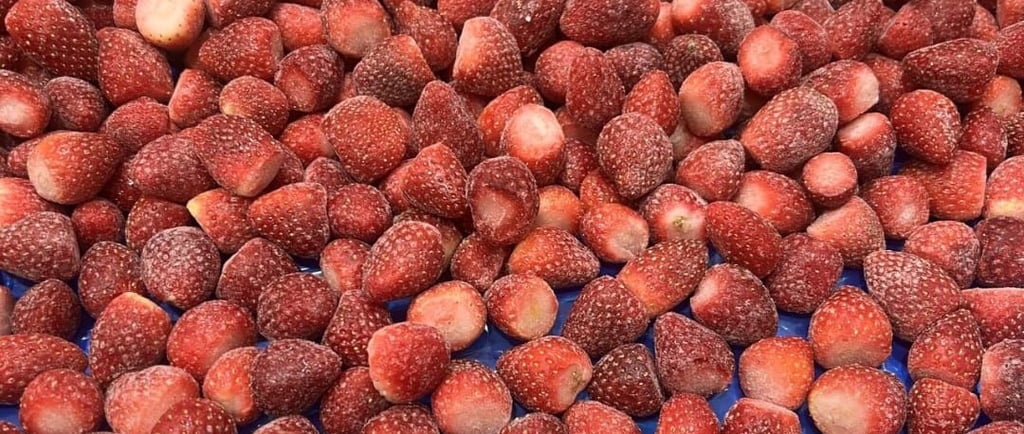
Individual Quick Freezing, using belt or spiral tunnel freezers running around −35°C. Each berry freezes separately within minutes, which keeps ice crystals small, protects the cell structure, and avoids the mushy texture that slower block-freezing methods produce.
Metal detection and quality checks before packing.
Packing and cold storage at −18°C or below until the product ships.
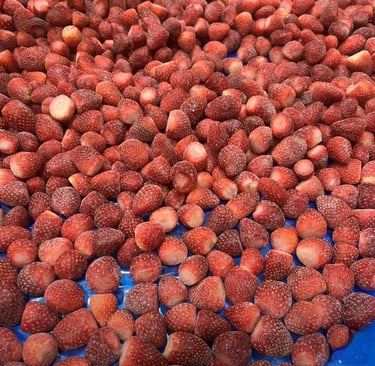
The result is a free-flowing product — berries that don't clump into a solid block — which makes portioning, blending, and further processing far easier for the buyer, whether the end use is a smoothie, a yogurt inclusion, a bakery filling, or a retail freezer bag.
Quality Standards & Certifications to Look For
Before contracting with any Egyptian supplier, importers should confirm current, valid certification — not just a logo on a website. At minimum, ask for:
GlobalG.A.P. good agricultural practice certification at farm level
BRC Food Safety or IFS Food at the processing facility
HACCP documentation
ISO 22000 food safety management
FDA facility registration for shipments bound for the United States
Kosher and/or Halal certification, where relevant to the target market
Request the exporter's current certificates and most recent third-party audit report directly, since certification status can change between seasons.
Packaging, Grading & Product Forms
Product forms typically available:
Whole berries
Sliced (commonly 4–6 mm)
Diced/cubed (commonly 10×10 mm)
Broken/crumble grade
Purée
Firmer varieties such as Fortuna and Camarosa tend to hold their shape best in whole-pack retail formats, while softer or surplus-grade fruit is more commonly diverted into sliced, diced, or purée lines for beverage, dairy, and bakery applications.
Typical grading benchmarks:
Grade A / Extra class as the standard export grade
Size calibration bands, such as 15–25 mm or 25–35 mm diameter
Brix commonly 7–9°+ minimum
Defect tolerance generally under 2–3%, with no foreign matter
Packaging formats:
Bulk export cartons with polyethylene liners, commonly in 10–20 kg formats for industrial buyers
Retail-ready poly bags for private-label programs
Custom branding and multi-language labeling available from many exporters for buyers building their own retail SKUs
Shipping & Logistics: Ports, Incoterms & Lead Times
Ports: Most shipments move through Alexandria, which handles roughly 60% of Egypt's foreign trade, or Damietta, which sits closer to the Delta growing regions and can mean a shorter inland haul for product sourced from Kafr El-Sheikh or Beheira. Both ports offer reefer-point container handling, and Egypt's Suez Canal position supports efficient onward routing — a dedicated Ro-Ro line, for instance, already connects Damietta to Trieste, Italy, moving refrigerated cargo to Europe in as little as 34 hours.
Incoterms commonly offered: EXW, FOB (Alexandria/Damietta), CFR/CIF into major European ports such as Rotterdam, Antwerp, and Hamburg, and DAP on request.
Cold chain: −18°C maintained end-to-end, often with a data logger placed in the reefer container to document the full transit.
Lead times: Typically a few days when shipping from existing frozen stock; several weeks for new production runs or first-time private-label programs.
MOQ: Many exporters can accommodate a single pallet for a trial or mixed order, while standing supply programs are usually built around a full 20-foot or 40-foot reefer container (a 40ft reefer typically loads in the range of 22–24 metric tons).
Documentation: Commercial invoice, packing list, phytosanitary certificate, certificate of origin, and — where EU preferential tariff treatment applies — a EUR.1 movement certificate.
Payment terms: Telegraphic transfer (TT) and letters of credit (sight or usance) are standard. New buyer relationships sometimes start with escrow or a partial-advance arrangement while trust is established.
Why International Importers Keep Choosing Egypt?
Egypt's frozen strawberry sector isn't a niche play, it's the category leader. Export-industry reporting for 2025 describes it as a record year, with frozen strawberries becoming one of Egypt's top food-industry exports by value. Demand is broad-based rather than concentrated in one region: major destinations include Western Europe (the Netherlands, Belgium, France, Germany, and the UK), a growing share of Eastern Europe, the Middle East and Gulf, East Asia (Japan and South Korea), and North America. For global frozen-fruit buyers, that combination — counter-seasonal supply, a competitive cost base against other major origins, Suez Canal logistics, and a certified industrial base — is why Egypt increasingly shows up as either the primary or the backup origin in annual sourcing contracts.
Frequently Asked Questions
What is the minimum order quantity (MOQ) for IQF strawberries from Egypt?
Most exporters can accommodate a single pallet for a trial order, though standing supply programs are typically built around full 20-foot or 40-foot reefer containers.
Is Egyptian IQF strawberry available year-round, or only during harvest season?
Fresh harvesting runs roughly November through April or May, but because frozen stock is held at −18°C with a shelf life of around 24 months, importers can place orders and receive shipment throughout the year from existing inventory.
Which strawberry variety is best for smoothies and purée versus retail packs?
Firmer varieties such as Fortuna and Camarosa tend to hold their shape best in whole-pack retail formats. Softer or surplus-grade fruit — across most varieties — is more commonly diverted to sliced, diced, crumble, or purée lines for beverage and bakery applications.
What certifications should I request from an Egyptian strawberry exporter?
At minimum, ask for GlobalG.A.P. at farm level, BRC or IFS Food certification at the processing facility, HACCP documentation, and, for US-bound cargo, confirmation of FDA facility registration.
Can Egyptian exporters produce private-label packaging?
Yes. Many established exporters offer private-label and custom packaging, including multiple label languages, though lead times for new private-label runs are typically longer than shipping from existing bulk stock.
How far in advance should I book for the December–February peak season?
Because peak-season fruit carries the highest Brix and deepest color, and volumes are in highest demand during that window, importers typically get the best allocation and pricing by confirming contracts before the season opens in September or October.
Ready to Source IQF Strawberries from Egypt?
Agrinile works directly with growers and BRC/HACCP-certified processing facilities across Egypt's Nile Delta to supply IQF strawberries: whole, sliced, or diced to importers, food manufacturers, and distributors worldwide. Contact us at info@Agrinile.co to request current specifications, certificates, and a sample quotation ahead of the upcoming season.
Agrinile
Reliable exports of fresh Egyptian produce worldwide
Contacts
Stay Updated
© 2026. All rights reserved.
Navigate